Chefchaouen Weather: Best Time to Visit the Blue City
Published · Updated
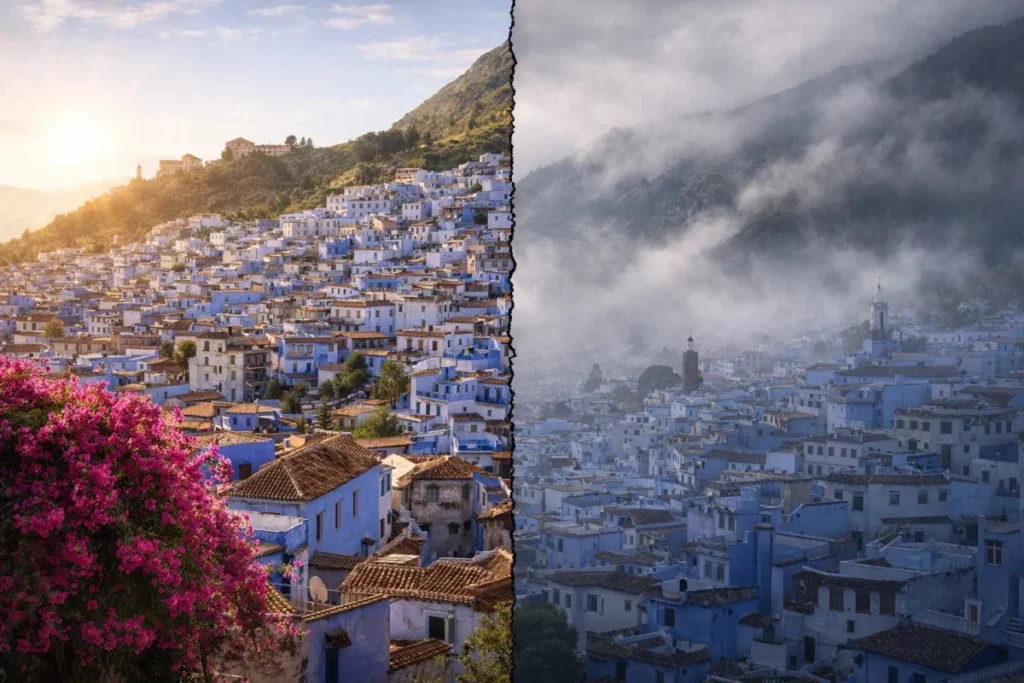
A bright morning in the blue streets and a cloudy afternoon in the Rif can call for very different plans. For a Chefchaouen stay, choose your season with the activities you enjoy in mind, then use a current forecast to plan individual days. A city walk and a mountain excursion need different preparation.
Travel-planning sources were checked on 5 November 2026. This guide separates three kinds of information: general seasonal guidance, historical climate averages and current forecasts. No numerical monthly climate averages are presented because a suitable station, reference period and dataset have not been verified for this article.
In this guide
Current weather in Chefchaouen
Check a recent local forecast shortly before travelling, and again before any weather-dependent outing. A city forecast is a starting point; it does not establish conditions on a particular trail or river crossing.
If a forecast appears above, its provider, valid time and update time are shown with it. A model estimate is not an observation from a weather station. When data is unavailable or too old, no temperature is displayed.
Typical weather by month: a practical overview
This is qualitative planning guidance, not a table of measured monthly climate averages. The Moroccan National Tourist Office recommends April–June and September–October for generally mild conditions, and notes that winter can be rainy. Source: Visit Morocco’s Chefchaouen guide.
| Month | Planning approach |
|---|---|
| January | Winter: allow for rain and cold-weather changes. |
| February | Winter: keep outdoor plans flexible. |
| March | Spring transition: check conditions before longer outings. |
| April | Spring: consider separate town and outdoor days. |
| May | Spring: leave space for a change of plans. |
| June | Early summer: check each day’s heat forecast. |
| July | Summer: consider earlier walks and time in the shade. |
| August | Summer: check heat guidance before strenuous plans. |
| September | Consider a combination of town and outdoor time. |
| October | Keep a light layer and rain cover handy. |
| November | Approaching winter: allow for changing conditions. |
| December | Winter: pack layers and leave room to change plans. |
Chefchaouen through the seasons
Spring: March to May
Spring is a useful season to consider for walking-focused visits. April and May fall within the national tourist office’s recommended period. Rather than promising sunshine or full waterfalls, plan a mix of outdoor time and shorter town visits that can be rearranged.
Summer: June to August
For a summer trip, use the forecast to decide when to walk, rest or travel. Pack sun protection, carry drinking water and consider doing longer walks earlier in the day. These are planning suggestions, not a guarantee that a particular route or day will be suitable.
Autumn: September to November
September and October are the tourist office’s other recommended mild-weather months. Keep a light extra layer and a rain shell handy, and avoid treating a seasonal recommendation as a prediction for your exact dates.
Winter: December to February
The tourist office notes that winter can be rainy. Pack layers and rain protection, and keep an indoor or shorter-walk alternative to a mountain day. Ask your accommodation about the heating arrangements you need rather than assuming every house or room has the same facilities.
For a mountain excursion, discuss the intended route and current conditions with a qualified local guide. A general winter forecast does not establish whether a particular trail, road or river crossing is usable. Check Morocco’s national weather service for current information and warnings.
Best months for sightseeing and hiking
For a first sightseeing trip, April–June or September–October are reasonable starting points when choosing dates. For hiking, treat those same periods as options to investigate, not blanket assurances of access or safety. Confirm your intended route, current local advice and weather warnings before committing to an outing.
A pleasant forecast for Chefchaouen does not confirm the condition of Akchour’s paths or God’s Bridge. Ask about the specific route, and change plans when conditions do not suit the walk you intended.
What to pack for changing conditions
- Comfortable footwear suited to your planned walking.
- Layers you can add or remove, plus a rain shell.
- A hat, sunglasses and your usual sun protection.
- A reusable bottle and a plan for carrying enough drinking water.
- A charged phone and saved directions for your journey.
- Extra warm clothing for a winter itinerary, chosen after checking the forecast.
Pack for the activities you will actually do. A leisurely visit to the medina and a mountain outing may need different footwear, equipment and preparation.
Frequently asked questions
When is the best time to visit Chefchaouen?
Start by considering the tourist office’s mild-weather windows above, then choose dates that suit your plans and check a current forecast. There is no universally best month for every traveller.
Will it rain during my stay?
A seasonal guide cannot answer that for your dates. Use an up-to-date forecast, keep plans flexible and remember that forecasts can change.
Does a mild-weather month guarantee a good hiking day?
No. Choose the particular route with current local advice, then check its forecast and access conditions. Leave room to change plans; monthly guidance cannot establish that a path or crossing is suitable.
Is the weather panel a local station reading?
No. When available, the panel uses MET Norway’s model forecast. Its valid time and provider update time matter more than the fact that a page has just loaded. When it is unavailable, use the linked national service instead.
Are monthly averages the same as a forecast?
No. Climate averages summarize a defined historical period; forecasts describe expected conditions for particular future times. The overview above uses seasonal descriptions rather than numerical monthly averages.
Useful Chefchaouen travel links
- Morocco’s national meteorological service for current weather information and warnings.
- The official Chefchaouen destination guide.
- Plan an outing around Talassemtane.
- Planning the Casablanca–Chefchaouen journey and continuing from Tangier.
- Restaurant ideas for a flexible town day.
A comfortable starting point for your stay
Casa Olea Vista is an entire guest house in Chefchaouen, with two bedrooms for up to seven guests, an equipped kitchen, Wi-Fi and free parking. Explore the house or contact the host with your dates and guest count. Availability and arrangements are confirmed by the host.
A LITTLE MORE TO DISCOVER
Keep exploring.
Nature & seasons
Talassemtane National Park: A Practical Visitor Guide
Plan a Talassemtane visit from Chefchaouen with verified landscape context, outing choices, weather checks and responsible visitor preparation.
Read the guide — Talassemtane National Park: A Practical Visitor Guide